
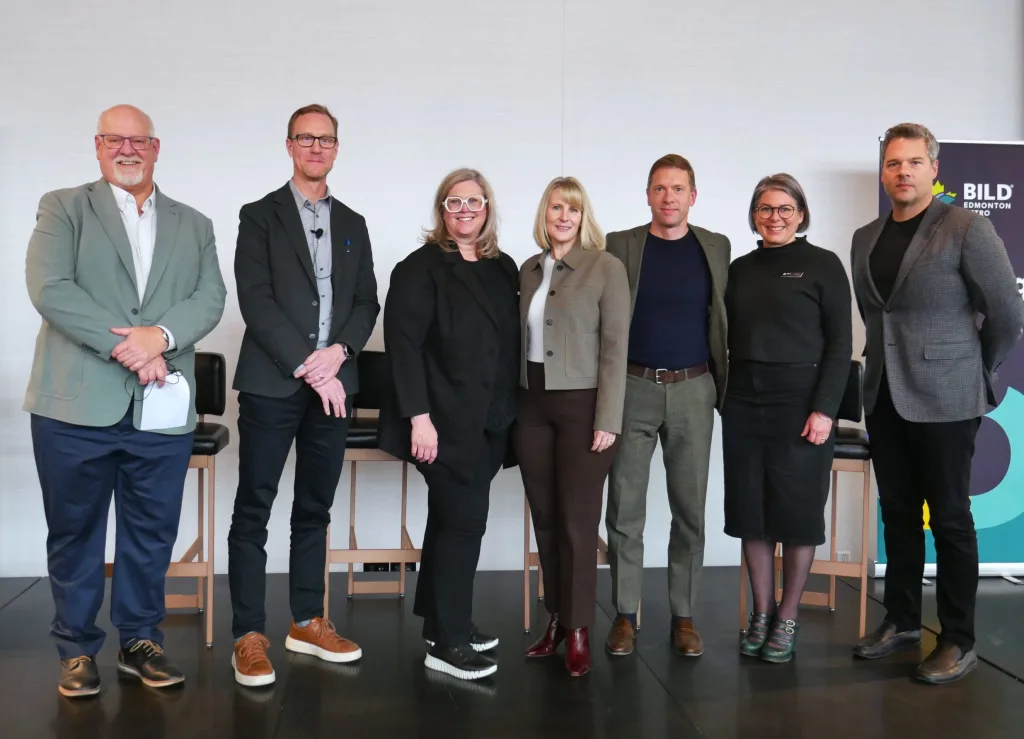
Amie Blanchelle (BILD Calgary) , Mike Kohl (Brookfield Residential),
Kalen Anderson (BILD Edmonton Metro), and Paul Lanni (Averton).
For more than a century, there has been an unspoken sibling rivalry between Calgary and Edmonton. From which one has the better professional sports teams, to which foodie scene is superior – it is a deep divide that can’t seemingly be surmounted. But in terms of housing, Alberta’s two biggest cities may have more in common than they think.
The rivalry is real! Just ask any Edmonton Oiler or Calgary Flames fan. And it has existed since Alberta was founded in 1905 and Edmonton was chosen over Calgary as the provincial capital; maybe even before that when Calgary was picked by the Canada Pacific Railway to be its hub instead of the city to the north. Today, the battle over culture, politics, economy and who is the best at what is livelier than ever.
But when it comes to housing, they both benefit from the “Alberta Advantage.” Edmonton and Calgary remain significantly more affordable than many major Canadian centres, with competitive approval timelines, fees, and tremendous opportunities for growth and investment. But rising costs, infrastructure gaps, and uncertainty are putting pressure on that advantage.
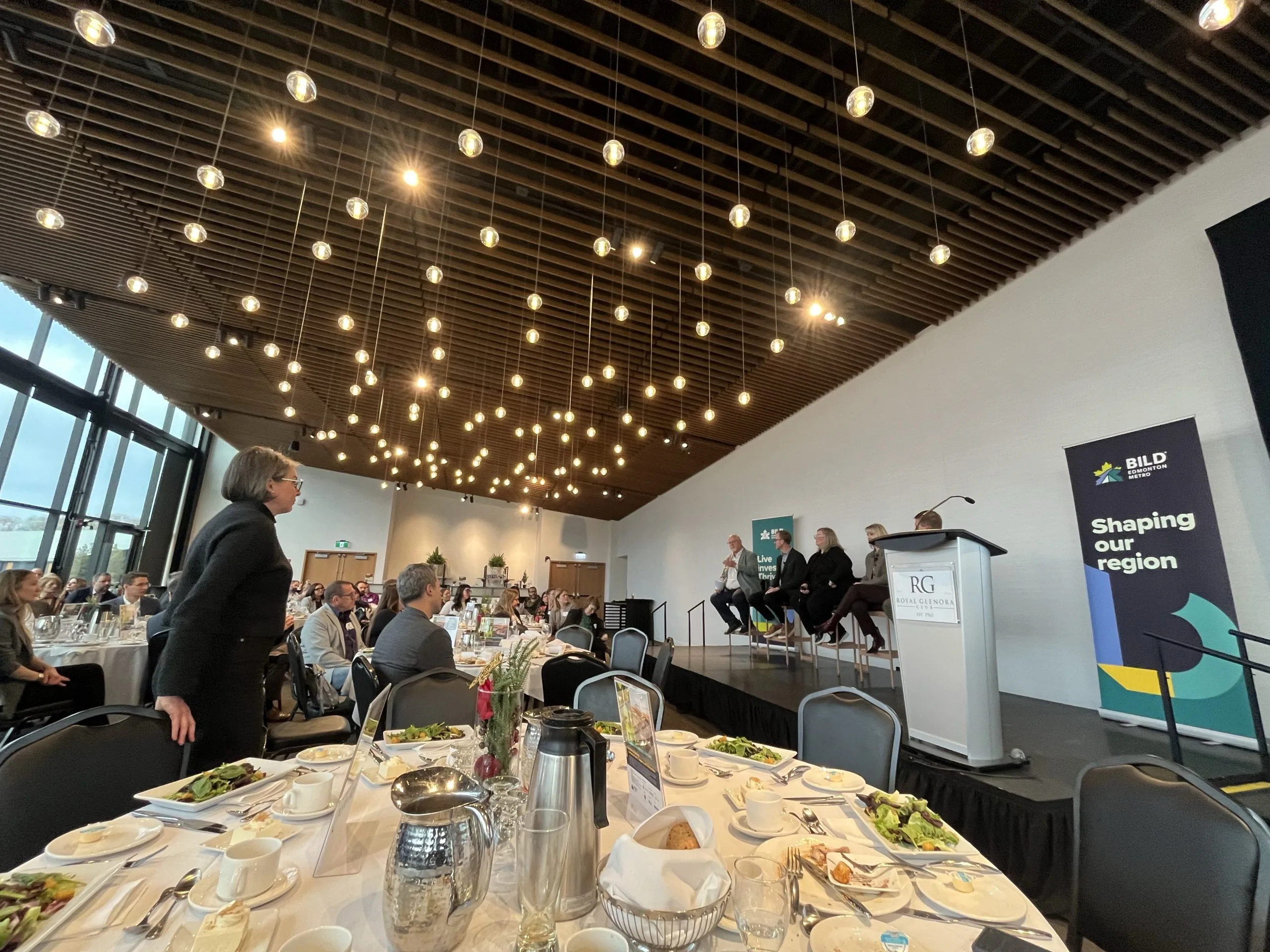
At a luncheon in November, BILD Edmonton Metro invited panelists from both of Alberta’s biggest cities to compare and contrast how they handle challenges and opportunities for their respective housing industries. The panel compared how Calgary and Edmonton approach city-building — covering infrastructure, water, streets, policy, standards, approvals, and regulation — and exploring what each city can learn from the other to build better, faster, and smarter.
Setting the stage
The conversation was moderated by Mike Kohl of Brookfield Residential, and he was joined by Amie Blanchette of BILD Calgary, Kathy Oberg of CIMA+ and B&A, Craig Bonneville of EPCOR, and Russell Dauk of Rohit Group of Companies. BILD Calgary groups over 600 organizations to give voice to Calgary’s new home and land development industry, CIMA+ deals with Alberta infrastructure projects, EPCOR is a City of Edmonton-owned utility company, and Rohit Group has major home and land development investments in both cities.
Panelists were asked to look back over the past five years and see what projects or decisions — whether successes or cautionary tales — offer the clearest lessons about how Calgary and Edmonton should approach growth and development going forward.
Panelists emphasized finding ways to streamline approvals, policy, and development standards to build faster and more efficiently — without losing sight of the livable, well-connected communities being created.
Building it better
Finding a way to collaborate with municipal administrations has been a thorny issue in both cities. Conflicting agendas, and unpredictability were pointed to as blockades to development goals.
BILD Calgary’s Blanchette says “analysis paralysis” is a problem. “At times, uncertainty can arise around how best to move forward together. One of the most effective ways to overcome these challenges is to create space for open and honest conversations about the issues we face, and to approach them with a collaborative mindset focused on finding solutions.”
Lessons learned
Infrastructure problems also came up in discussions, with the series of water main breaks in Calgary and the investments needed for their repairs resulting in astronomical price hikes in the city’s budget.
Some lessons were still learned in the debacle, Blanchette says. “I would say one of the great lessons to be learned here, though, is we have figured out private industry can move this stuff, can move it faster, can do it differently. Is it constrained in the same way if I can develop procurement issues around? And so that that gave us knowledge, that we wouldn’t have had before. To have that conversation getting us through to the table, collaborate, get involved in figure out how to do something faster.”
Bonneville says that the resulting property tax increases just put Calgary to where they should have been already if they had properly invested in the infrastructure upkeep.
“That’s not to say that that, you know, infrastructure was mismanaged, or that even if it could have necessarily prevented a failure,” he states. “We experience issues just like every municipality does. But if you can build that infrastructure as resilient, then you can manage to build those crises a lot better.”

Working with Council
A further complication is navigating what could be choppy waters coming from City Councils with divergent agendas.
“It’s a struggle to balance all the political priorities and the ever-evolving planning process,” Oberg says. “We realize we will have to do a lot of education with elected and municipal officials over the next three years on our challenges and to think about the future.”
Oberg also expressed shock at how public engagement has changed. “You literally have to be strategic right from the start. Before, it was the kindness game, and now it’s a political game. We need to build great cities, and that’s usually done when we’re having great conversations with folks and not trying to justify them.”
Bonneville says providing the right information to City Council is key. “I don’t expect municipal councilors to understand all the granular aspects about infrastructure, but providing the right information so that they can make informed decisions that benefit the city benefits all of us in the long term.”
A moral responsibility
But in the end, Dauk believes that there is a responsibility for public and private institutions to work together to provide the best infrastructure. “This is not just a tactical thing or a political thing. It’s a moral act,” he says. “There’s a moral responsibility for public and private sectors to find the most cost-effective way, always, because the implications are huge, and we forget that, because we’re always just thinking about the next subdivision of the next house.”
Dauk does believe it is imperative to plan for the future but predicting what the future will bring can be almost impossible. But planning needs to happen.
He cites a recent issue in Calgary where the number of Uber Eats deliveries at schools is causing problems as there are not a lot of designated drop-off areas for that. But those who designed the schools some 30 years ago could not have predicted such a change.
“So that’s the thing is, like, we sometimes get brief about this future problem, but the problem is right in front of us today. Immigration gets turned on by the government. There’s going to be a million people. What are you doing about it tomorrow? And if we mess that up, then you get that affordability cycle gone, then you mess up a lot of things. So, the adaptability is part of what you’re buying for, has to do with your infrastructure, is adaptability. It’s not going to be perfect, but the more that you can be flexible and recognize the moment in time that you have to deal with, the less will screw up today.”