
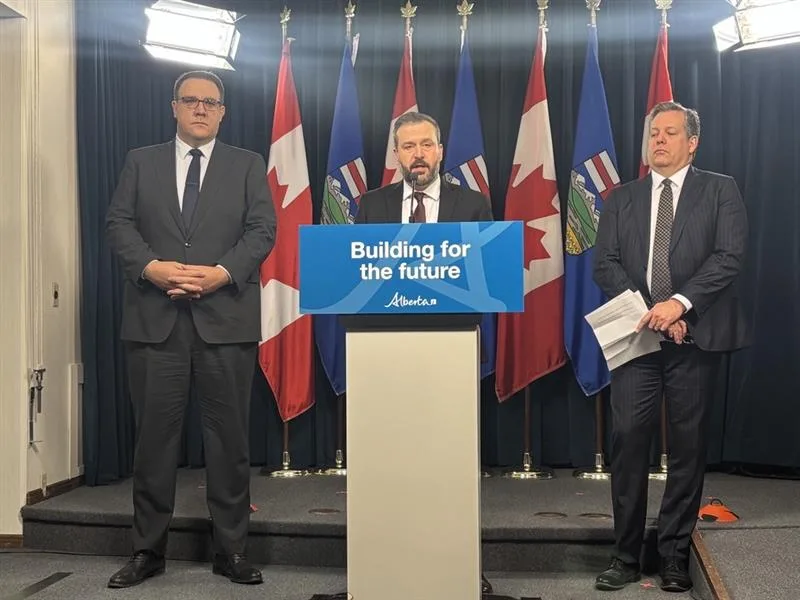
In January of 2026, The Honourable Jason Nixon and industry from across the province came together to celebrate a major milestone: Alberta has shattered housing construction records for the second consecutive year. The Minister announced that, for the first time in Alberta’s history, more than 50,000 housing starts were achieved in a single year, with over 53,000 homes breaking ground in the past 12 months.
The Edmonton Metro Region played a significant role in this achievement. In the Edmonton Census Metropolitan Area’s (CMA), housing starts rose from 18,384 in 2024 to 21,337 in 2025 – an increase of 16.1 per cent, and the highest growth ever recorded.
In the surrounding municipalities, growth was stellar. Four municipalities exceeded the regional average, including Beaumont at 6.3 per cent, Leduc County at 4.7 per cent, Spruce Grove at 4.2 per cent, and the City of Edmonton at 3.4 per cent.
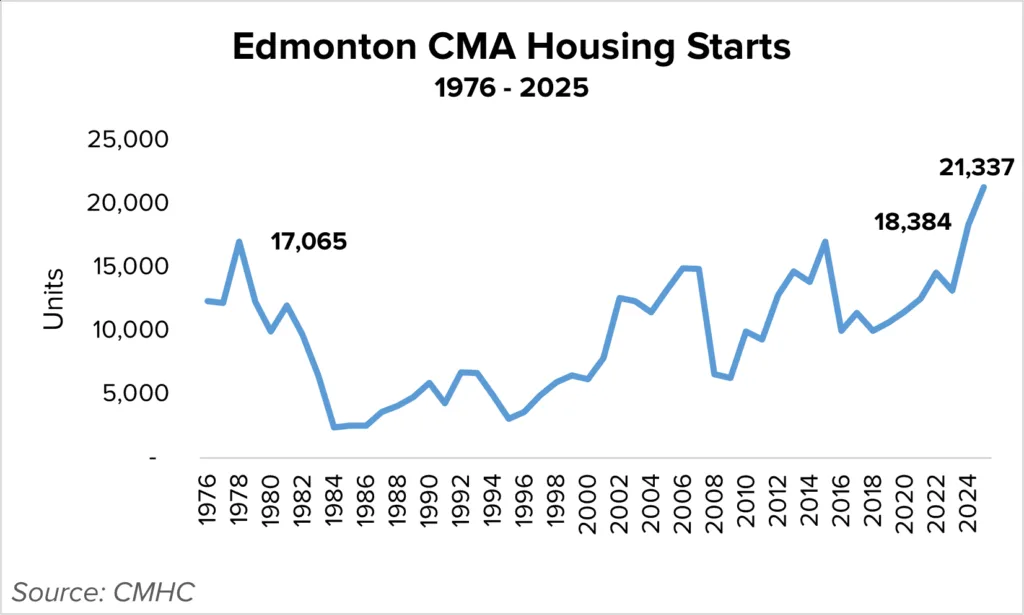
As more choose Edmonton and the surrounding region as a place to live, the building and development industry – including developers, builders, and skilled trades – has stepped up to meet the moment, working to ensure housing supply keeps pace with growing demand.
So where is that demand coming from? According to Statistics Canada’s most recent population estimates, Edmonton (CMA) grew by 3.1 per cent, edging out Calgary’s growth rate at 2.9 per cent.
According to the Government of Alberta, “despite making up less than 12 per cent of Canada’s population, during 2025 Alberta built almost a quarter of housing starts in the country,” and that Alberta was “responsible for more than 80 per cent of all housing starts across the prairies.”
Outgrowing the Projections
The City Plan, Edmonton’s municipal development plan, envisioned the city growing from one to two million people over a forty-year period. By 2025, Edmonton’s population grew to 1.24 million, just shy of 1.25 million, or the the first population threshold from The City Plan, which had been envisioned to take 12 to 15 years to achieve.
“We are much further along than anticipated in terms of growth at this point,” said CEO of BILD Edmonton Metro Kalen Anderson. “This reflects the region’s strong commitment to delivering affordable, diverse housing options, supported by more efficient and streamlined development processes. People are voting with their feet by moving to the Edmonton region and our industry is meeting that need to provide the housing they desire better than the rest of Canada”
How We’re Growing
Both public-sector policy and private-sector development play critical roles in meeting the current growth demand. The region’s ability to address housing affordability and growth is due, in part, to streamlined policies, development charges, and permitting processes.
In 2024, the City of Edmonton’s Zoning Bylaw’s regulations were streamlined, making the permitting application process clearer and simpler for users across the entire region. These changes allow for an increase in density, particularly in established areas, while also considering neighbourhood context.
With streamlined planning policies, lower homebuilding costs and more predictable development fees, more affordable housing options are able to be built. While more work can always be done to reduce red tape, costs and delays across local jurisdictions, Alberta stands out in the country as a clear leader.
In addition, the Auto-Review system was implemented, an AI-enabled permitting approval process for single-detached and semi-detached homes in developing neighbourhoods. By accelerating and simplifying the process, there’s now a faster pathway for housing and new innovations for enhanced reporting, an achievement from the collective work of the region’s 13 municipalities.
Over the years, the Edmonton region has become a increasingly attractive destination for young professionals, families, immigrants, and workers, likely because of lower housing costs and the ability to match residents’ needs and lifestyles.
As of late 2025, the Edmonton Region average residential home price stands at $458K, which is significantly lower than most metro regions across the country.
The new single-family home price for Edmonton is $651K, which marks an all-time high for the region, and sits at $200k less than the exact same product in Calgary.
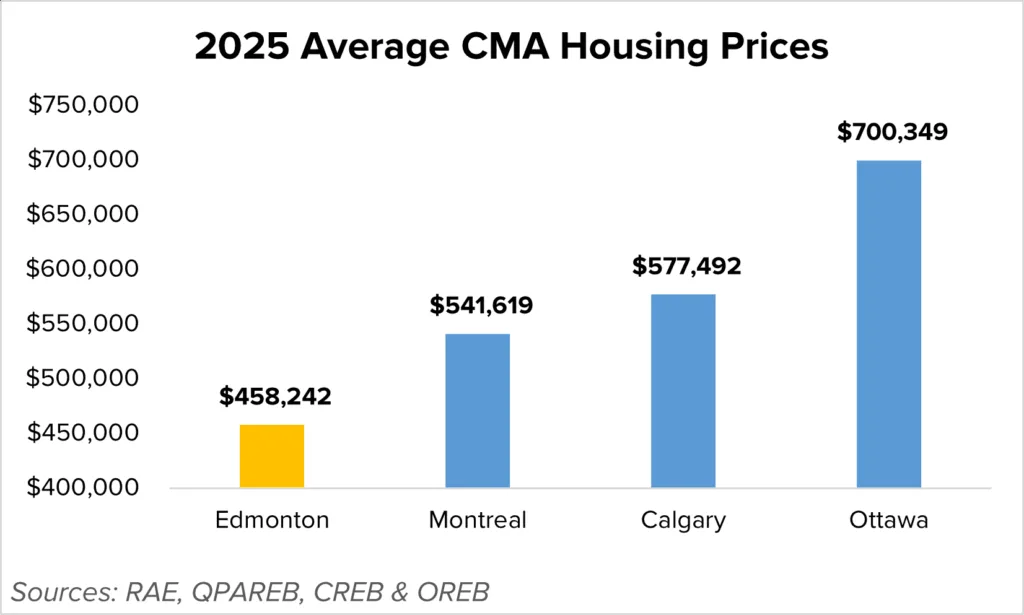
The key to maintaining Edmonton’s affordability advantage lies in continually removing development constraints, allowing more density, and providing a wide range of housing options.
Leading the Way
Edmonton’s growth story isn’t just about numbers — it’s about outcomes.
Standardized zoning regulations, record housing starts, and housing diversification have been translated into real supply, helping the city grow while keeping prices at affordable levels. While some regions continue to face development challenges, Edmonton continues to work to overcome them.
“Alberta’s record housing starts show what’s possible when barriers are reduced and regulatory systems evolve to support growth,” shared Scott Fash, CEO of BILD Alberta.
Being unique is nothing new for the Edmonton region, and streamlining processes and expanding housing supply can reflect that reality, particularly when other regions are marred by bureaucratic barriers to growth. Alberta’s capital region didn’t rank number one by playing it safe; it ranked number one by taking chances, working smarter, and playing a little offense.
Written by Payton Phillips and Garren Sharpe