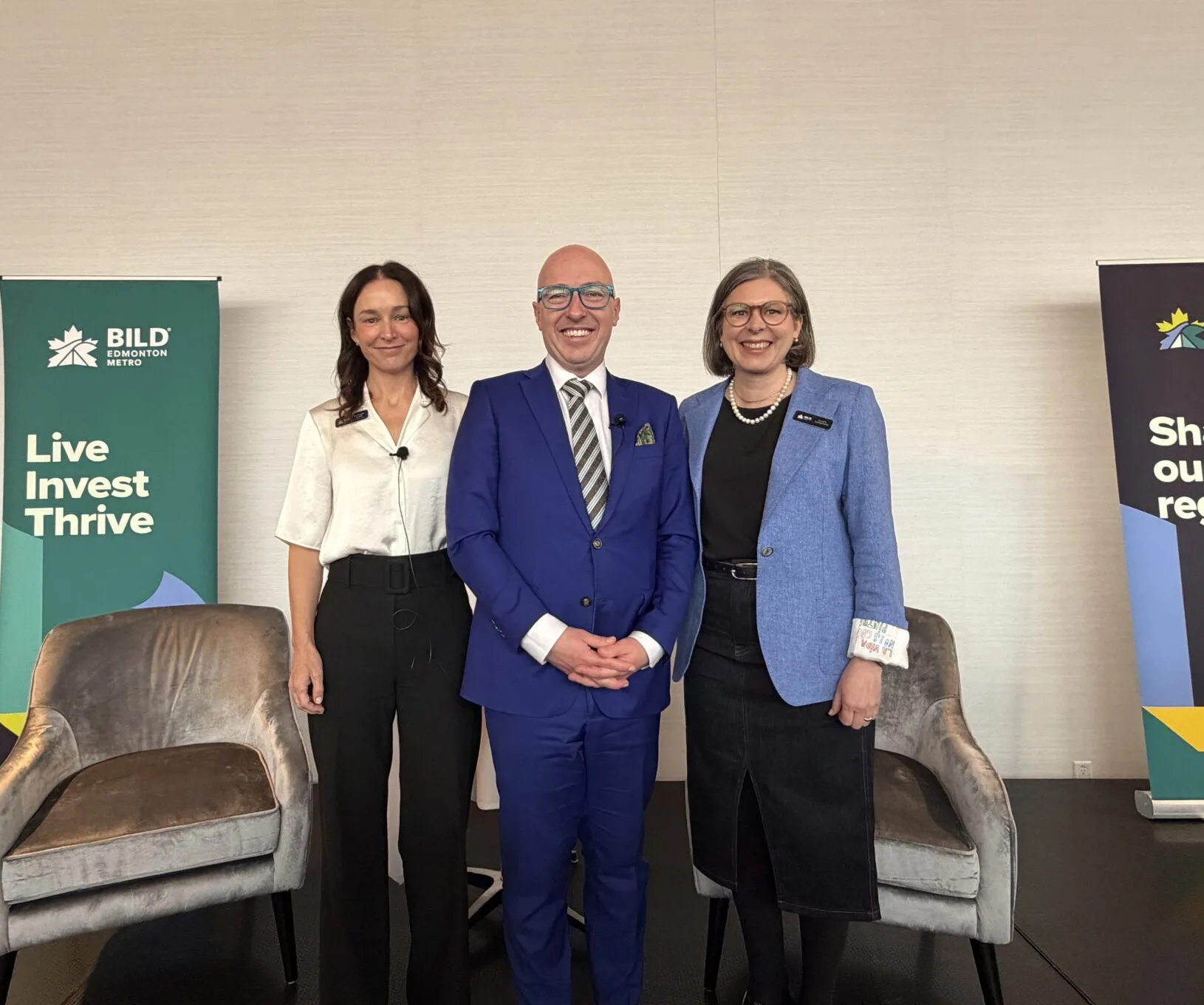
In front of a sold-out audience, BILD Edmonton Metro hosted its first luncheon of the year, featuring Edmonton Mayor Andrew Knack. The event brought together more than 230 leaders from across the building and development industry for a timely conversation about Edmonton’s future and the priorities shaping the city’s next chapter.
The luncheon marked one of the Mayor’s early opportunities to engage directly with the region’s development community — and for industry leaders to hear firsthand about his vision for growth, investment, and long-term prosperity in Edmonton.
“This feels like my one hundredth BILD event over the past week,” joked the Mayor. “But in all seriousness, this is an important organization that helps the City achieve its goals. I’m delighted to be here today to share Council’s vision for Edmonton’s future and talk about how we plan, invest, and grow over the next few years.”
From land developers and home builders to planners, engineers, and trades, BILD members play a foundational role in shaping the communities where people live, work, and invest. The homes, neighbourhoods, and commercial spaces created by the industry support economic growth, attract talent, and contribute to Edmonton’s long-term prosperity.
“As the city continues to grow, collaboration between the public and private sectors will remain essential to ensuring that growth is both sustainable and successful,” said Katrina Rowe, Chair of BILD Edmonton Metro’s Board of Directors. “I’m excited to hear more about the Mayor’s priorities and how we can work together to accommodate growth and investment.”
A Timely Conversation About Edmonton’s Priorities
The discussion comes at a pivotal moment for Edmonton. With strong population growth, sustained housing demand, and evolving economic opportunities, the decisions made today will shape the city for decades to come.
Throughout the luncheon, several key themes emerged — from housing supply and affordability to economic growth and investment, growth management and infrastructure, and the vitality of downtown and local communities.
Housing Supply and Affordability
Maintaining Edmonton’s leadership in housing starts and ensuring a diverse range of housing options were central to the discussion.
The Mayor highlighted that City Council recently approved a new strategic plan built around priorities such as economic development, growth management, quality services, and community safety. The plan is guided by three key principles: affordability, fiscal sustainability, and strong relationships with partners.
When asked how the City plans to maintain Edmonton’s strong housing supply and relative affordability, the Mayor emphasized the importance of building on what is already working.
“We have to remind folks of the success we’ve already achieved. We didn’t get here by accident,” he said. “We’re the last major city where you can afford a home. So we need to stay the course — permissive policies, faster timelines, reduced red tape, proactive planning, and strong partnerships with industry.”
Industry leaders echoed the importance of policies and processes that enable housing to be delivered efficiently and at scale.
Economic Growth and Investment
Participants also discussed Edmonton’s role in attracting investment, supporting job creation, and strengthening the local and regional economy.
The Mayor highlighted the importance of a strong and vibrant downtown, pointing to successful public-private collaboration on the Capital City Downtown Community Revitalization Levy and related initiatives, including the Downtown Student Housing Incentive and the Downtown Attainable Housing Incentive Program.
A strong downtown, he noted, contributes not only to economic prosperity but also to the fiscal and social health of the entire city.
Growth Management and Infrastructure
As Edmonton continues to expand, the conversation also explored how infrastructure, servicing, and growth management decisions can support both new development and redevelopment across the city.
Rowe asked about recent discussions at City Council regarding greenfield development, particularly in the Future Growth Area south of 41 Avenue.
“There have definitely been some tense conversations around the activation of lands south of 41st Avenue,” the Mayor said. “I believe our motions signal the importance of activating those lands, but the tension is around financial realities and how we plan for that growth.”
He also pointed to opportunities for greater collaboration between the public and private sectors in delivering key infrastructure.
“In this budget process, it’s clear we won’t be able to build up to four necessary fire halls on our own,” he said. “I hear that industry can build them cheaper and faster, but Council will need to have conversations about trade-offs. Maybe we forego some requirements so these services and amenities can be delivered.”
These discussions connect closely with the goals of The City Plan — the City’s long-term framework guiding Edmonton’s growth toward a population of two million people while remaining inclusive, connected, and economically competitive.
Industry and City Partnership
A recurring theme throughout the luncheon was the importance of strong collaboration between municipal leadership and the development industry.
Private investment drives growth, supports job creation, and delivers the homes, workplaces, and community spaces that Edmontonians rely on every day. When municipal policy aligns with practical realities and long-term vision, meaningful progress becomes possible.
“Housing affordability, public safety, downtown revitalization, and economic growth are top of mind — not just for City Council, but for our members and for every Edmontonian,” added Rowe.
“We all share the same goal: a city that is inclusive, connected, and economically strong — a place where people can find homes they can afford, build careers, and belong to vibrant communities. Our partnership with the City is essential to making that happen.”
Looking Ahead
As Edmonton continues to grow and evolve, collaboration between municipal leaders and the building and development industry will remain essential.
The conversation with Mayor Andrew Knack highlighted both the opportunities and challenges ahead — and the shared commitment to ensuring Edmonton remains a city where people choose to live, invest, and build their future.
“Edmonton has what it takes to succeed — a smart workforce, a growing economy, and people who show up to solve problems,” the Mayor said. “We don’t wait to make things happen.”
BILD Edmonton Metro looks forward to continuing the conversation and working with City leadership to support responsible growth, strong communities, and a prosperous future for the Edmonton region.
Thank you to the Presenting Sponsor, Primary Engineering and Construction, Host Bar Sponsor, Active Homes, Lunch Sponsor, Hi Signs, Water Sponsor, EPCOR, Support Sponsor, Whissell Contracting Ltd., and Creative Sponsor, MLZ Creative.
Written by Jason Syvixay